


When engineers sit down to specify a cooling fan, the first question is almost always the same: what is the real difference between a DC cooling fan, an AC cooling fan and an EC fan? It is not only about the power supply. The three types differ in working principle, airflow and static pressure, power consumption, noise, service life and cost – choose the wrong one and you either end up with insufficient airflow or a device that overheats and comes back for repair. In this guide, YUNFAN – a cooling fan manufacturer based in Shenzhen with 20 years of production experience – walks through one comparison table and four practical selection rules to help you choose correctly the first time.
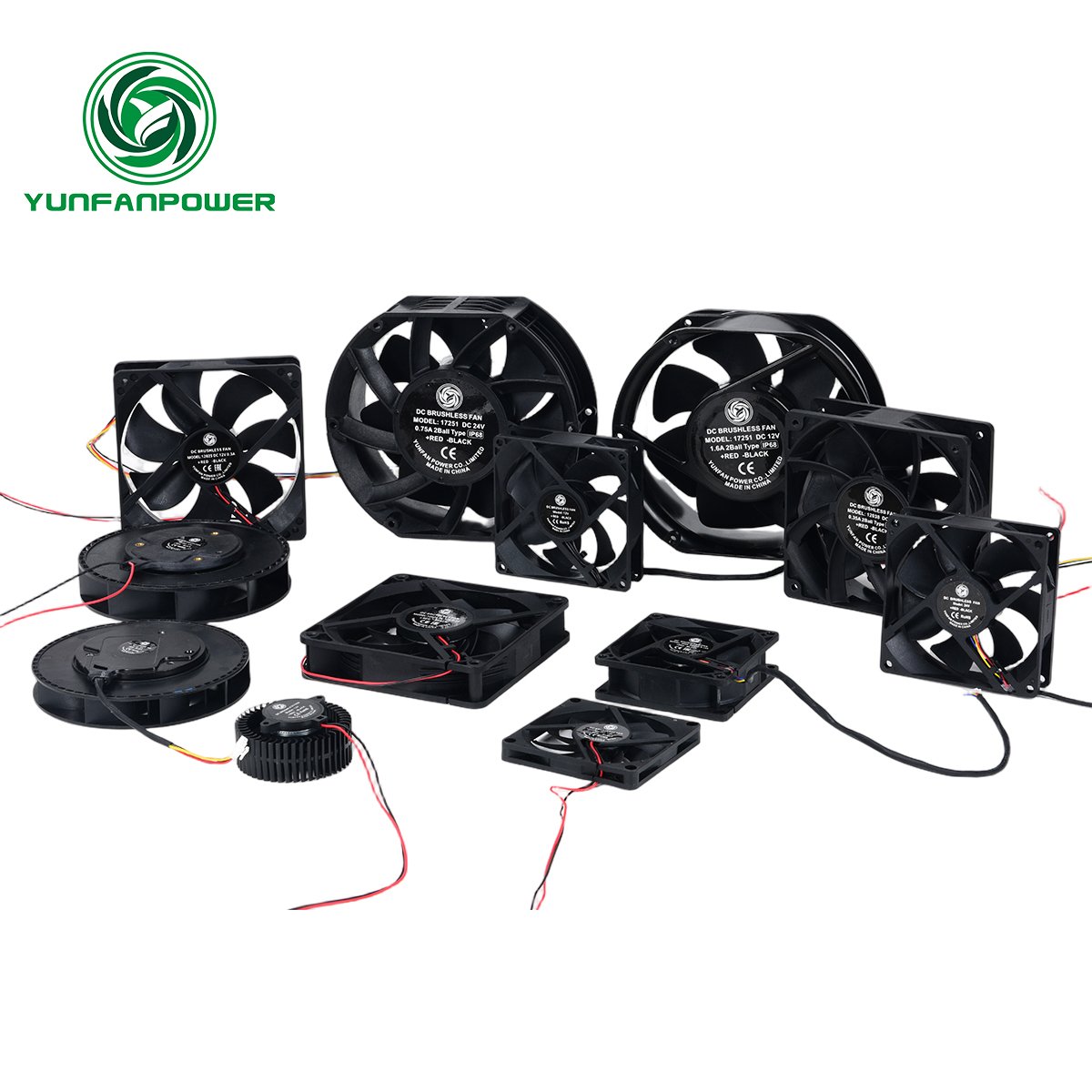
1. DC Cooling Fans: Low-Voltage DC Supply, Flexible Control
DC cooling fans run on 5 V, 12 V, 24 V or 48 V DC. The core is a brushless DC motor (BLDC): Hall sensors detect the rotor position and the drive circuit commutates the windings to keep the impeller turning. The advantages are clear:
- Low, safe operating voltage that can be tied directly to the device mainboard for intelligent thermal control;
- Supports PWM speed control with FG tachometer feedback and RD rotation alarm, so fan status can be monitored and speed follows temperature;
- The widest size range: from 20x20x6 mm micro fans up to 280×80 mm high-airflow axial fans, with 12 V / 24 V / 48 V options;
- Dual ball bearing versions reach 50,000 hours or more in high-temperature environments.
The limitation is that you need a DC rail – in a purely AC installation an additional AC/DC power module is required. Typical applications: PC power supplies, EV charging piles, 3D printers, CCTV cameras and telecom equipment. See our DC cooling fan category and DC blower series for full specifications.
2. AC Cooling Fans: Direct Mains Power, Rugged and Simple
AC cooling fans connect straight to 110 V / 220 V mains and use a shaded-pole or capacitor-run AC motor – simple construction, no driver board required.
- Wire it up and it runs: the lowest system cost and the simplest installation and maintenance;
- Tolerant of heat and dust, ideal for switchgear cabinets, UPS systems and welding machines running 24/7 in industrial environments;
- In large frame sizes (110-280 mm) they deliver strong, stable airflow and static pressure – the workhorse of enclosure cooling.
The limitation is a fixed speed that is hard to regulate, higher power consumption than EC at the same airflow, and a slight electromagnetic hum at start-up. Typical applications: distribution cabinets, inverter welding machines, stage lighting and industrial ovens. Full specifications in our AC cooling fan category.
3. EC Cooling Fans: Mains Input with a Brushless DC Motor, 50% Energy Saving
An EC fan is best understood as a brushless DC fan with a built-in rectifier and driver board: the mains voltage is rectified to DC internally and then drives a brushless motor. The result combines the easy AC connection with DC-level controllability.
- Roughly 50% lower power consumption than an AC fan of the same size – electricity cost falls noticeably over long runtimes and whole-machine energy targets become easier to meet;
- Supports PWM, 0-10 V and thermistor speed control, so airflow matches actual demand;
- High efficiency and low self-heating suit telecom cabinets, data rooms and fresh-air units that run continuously.
The limitation is a higher unit price than AC or standard DC fans, and surge protection should be considered on poor-quality grids. See the EC energy-saving fan category for the full range.
4. DC vs AC vs EC Cooling Fans at a Glance
| Parameter | DC fan | AC fan | EC fan |
|---|---|---|---|
| Power supply | 5-48 V DC | 110 V / 220 V mains | 110 V / 220 V direct (internal rectifier) |
| Speed control | PWM, FG / RD feedback | Fixed speed (a few tapped models) | PWM, 0-10 V, thermistor |
| Power consumption | Low | Higher | Lowest (~50% less than AC) |
| Life (ball bearing) | ~50,000 h | ~30,000-50,000 h | ~50,000-70,000 h |
| Noise | Low, can run slow | Medium, audible start-up | Lowest |
| Common sizes | 20-280 mm | 110-280 mm | 110-280 mm |
| Cost | Low | Lowest | Higher |
| Typical use | EV chargers, 3D printers, security, servers | Switchgear, UPS, welding machines | Telecom cabinets, data rooms, fresh-air units |
5. Four Selection Rules That Save You Rework
1. Start with the available power supply
If the device already has a DC rail or power module, choose a DC fan. If only mains is available and no speed control is needed, an AC fan is the most cost-effective. For equipment running 24 hours a day where electricity cost and energy-efficiency targets matter, go straight to EC – the price premium is usually recovered within one year of electricity savings.
2. Then match airflow and static pressure
If the air path contains filters, densely packed fins or other obstacles, system resistance is high and a high-static-pressure DC blower should be the first choice. For an open cabinet, a high-airflow axial fan is enough. When in doubt, share the system layout with your cooling fan manufacturer and ask for an airflow curve recommendation.
3. Noise and service-life requirements
Medical, office and household products are noise-sensitive: choose hydraulic or ball bearing solutions and prefer a large fan running slowly over a small fan running fast. For outdoor and damp environments specify an IP68 waterproof fan. In high-temperature environments always confirm the bearing type and temperature rating.
4. Prototype before mass production
Datasheet figures only tell half the story – actual temperature rise in the enclosure is the final criterion. Before a volume order, ask the fan manufacturer for samples and measure airflow, temperature rise and noise on the real machine. YUNFAN supports sample testing and OEM/ODM customisation.
6. Typical Applications
Requirements differ widely between industries, so we have documented cooling solutions for eight typical scenarios: UPS and power supplies, EV charging piles, telecom cabinets, medical devices, LED stage lighting, 3D printing, welding machines and CCTV security. Each page lists the recommended fan type, voltage and ingress protection rating so you can match a solution directly.
7. Frequently Asked Questions
Q1: Can an EC fan directly replace an AC fan?
Yes. EC fans accept the same 110 V / 220 V input, so as long as the mounting dimensions match they are a drop-in replacement with no wiring changes – and power consumption and noise usually drop noticeably afterwards.
Q2: How do I choose between 12 V and 24 V DC fans?
Follow the system supply: automotive and battery-powered products usually use 12 V, while industrial equipment, EV chargers and telecom gear typically use 24 V or 48 V. The higher the voltage, the lower the current, and the smaller the line loss and voltage drop – which matters for long cable runs.
Q3: What causes a cooling fan to be noisy?
The usual suspects are excessive speed, worn bearings, structural resonance and turbulent airflow. Start with a large, slow-running fan; then add PWM control so the fan slows down when temperatures are low; finally fit damping washers at the mounting points to kill resonance.
Q4: What determines the service life of a cooling fan?
Mainly the bearing type and the ambient temperature: sleeve bearings last around 20,000-30,000 hours, dual ball bearings 50,000 hours or more, and hydraulic bearings sit in between. FG tachometer feedback or RD rotation alarms give early warning of failure so the host device never overheats.
For DC / AC / EC cooling fan selection advice, free sample testing or volume pricing, contact us – YUNFAN replies within 24 hours. Certifications and third-party test reports are available on our certificate page.


 By


